Google x Foothill College Case Competition
BrainWave
AI-driven cognitive training for seniors developed for Google Case Competition
AI-driven cognitive training for seniors developed for Google Case Competition
Role
Product Designer, UX Researcher
Timeline
Oct 2024 - Nov 2024
Industry
Health & Wellness
Team
1 Product Designer + 1 Business Analyst + 4 Google Mentors
Google x Foothill College Case Competition
BrainWave
AI-driven cognitive training for seniors developed for Google Case Competition
Role
Product Designer, UX Researcher
Timeline
Oct 2024 - Nov 2024
Industry
Health & Wellness
Team
1 Product Designer + 1 Business Analyst + 4 Google Mentors
During the six-week Google × Foothill College Case Competition, our team explored how technology could better support older adults in maintaining cognitive health and engaging social connection.

As the UX designer, I focused on shaping the experience around the cognitive, emotional, and accessibility needs of older adults. Working with teammates from business backgrounds and incorporating feedback from Google mentors, I helped translate emerging AI capabilities into an experience that felt clear, approachable, and supportive.
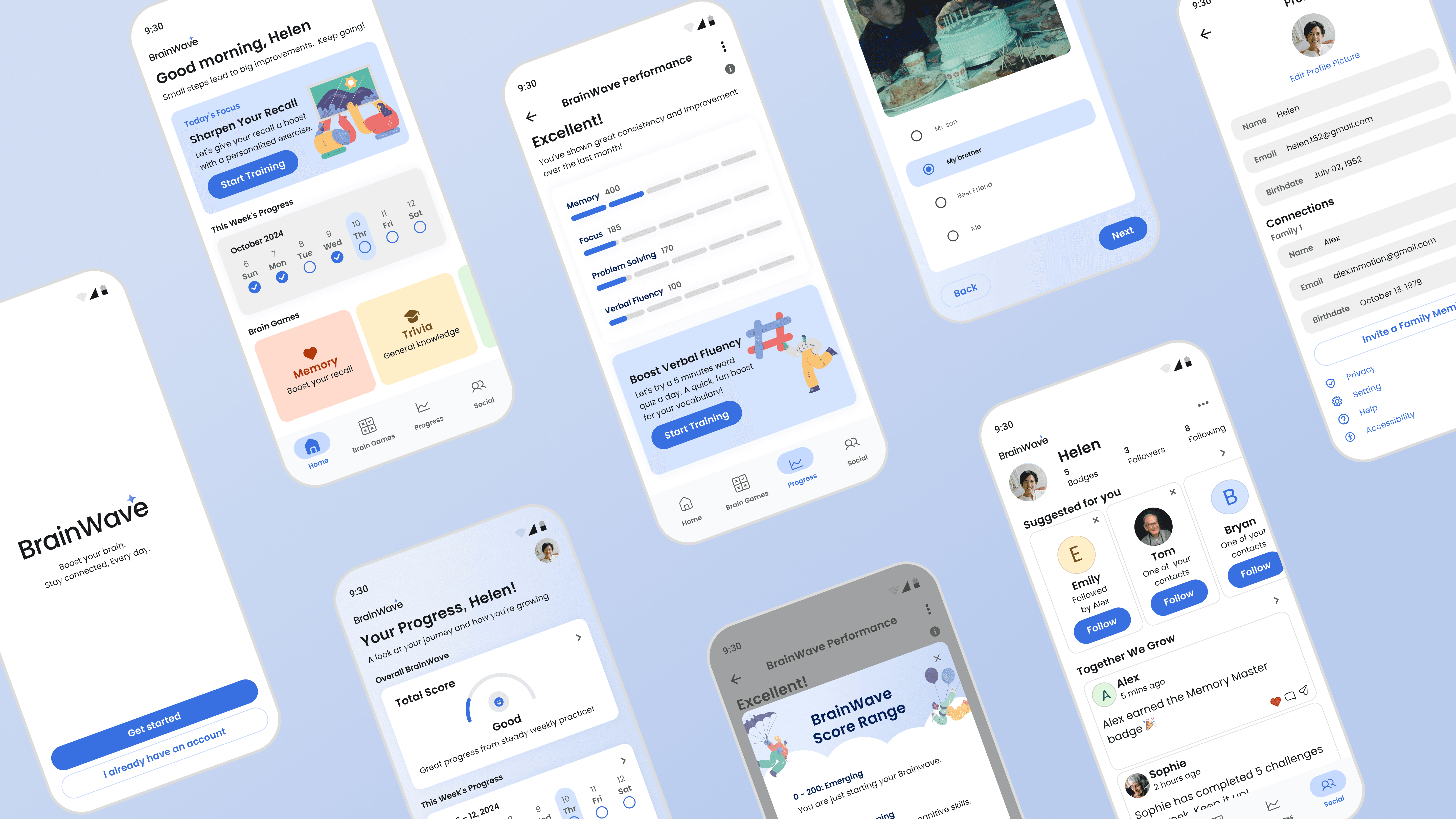
The result was BrainWave, a personalized cognitive training platform designed to support cognitive engagement, confidence, and meaningful connection in everyday life. BrainWave was selected as a finalist among 72 teams.

During the six-week Google × Foothill College Case Competition, our team explored how technology could better support older adults in maintaining cognitive health and engaging social connection.
As the UX designer, I focused on shaping the experience around the cognitive, emotional, and accessibility needs of older adults. Working with teammates from business backgrounds and incorporating feedback from Google mentors, I helped translate emerging AI capabilities into an experience that felt clear, approachable, and supportive.
The result was BrainWave, a personalized cognitive training platform designed to support cognitive engagement, confidence, and meaningful connection in everyday life. BrainWave was selected as a finalist among 72 teams.

Problem

Solutions


Design Process

Research
User Interview
I interviewed adults aged 65 and older to understand how cognitive health, technology, and social connection show up in their everyday lives. The conversations helped me identify not only usability challenges, but also the role of confidence, familiarity, and personal relevance in keeping people engaged.

I interviewed adults aged 65 and older to understand how cognitive health, technology, and social connection show up in their everyday lives. The conversations helped me identify not only usability challenges, but also the role of confidence, familiarity, and personal relevance in keeping people engaged.
User Survey
Alongside the interviews, I conducted a survey across multiple age groups to understand broader attitudes toward cognitive health and how people currently use brain-training tools. This helped me compare individual experiences with larger patterns in awareness, motivation, and usage.

Across both methods, a consistent pattern emerged: cognitive activities felt more engaging when they connected to familiar experiences and personal context rather than generic exercises. Social interaction also appeared to play an important role in motivation and continued participation.
These findings shifted the design direction toward personalized training experiences that adapt to the individual and incorporate social interaction as part of the experience.
Alongside the interviews, I conducted a survey across multiple age groups to understand broader attitudes toward cognitive health and how people currently use brain-training tools. This helped me compare individual experiences with larger patterns in awareness, motivation, and usage.
Across both methods, a consistent pattern emerged: cognitive activities felt more engaging when they connected to familiar experiences and personal context rather than generic exercises. Social interaction also appeared to play an important role in motivation and continued participation.
These findings shifted the design direction toward personalized training experiences that adapt to the individual and incorporate social interaction as part of the experience.
Research
Market Opportunity
The brain training market is projected to reach $1.6B by 2050, reflecting growing demand for digital health solutions that support cognitive well-being as the global population ages.


The brain training market is projected to reach $1.6B by 2050, reflecting growing demand for digital health solutions that support cognitive well-being as the global population ages.
Research
Competitive Analysis
Competitive analysis showed that most cognitive training products emphasize exercises and performance tracking, leaving room for a more inclusive and socially connected experience for older adults.

Competitive analysis showed that most cognitive training products emphasize exercises and performance tracking, leaving room for a more inclusive and socially connected experience for older adults.

Define
Personas

Define
User Journey
Based on the personas, I mapped the user journey to identify where older adults might experience friction, uncertainty, or disengagement across the experience. This helped shape an onboarding flow and interactions designed to reduce cognitive load and support continued use.

Based on the personas, I mapped the user journey to identify where older adults might experience friction, uncertainty, or disengagement across the experience. This helped shape an onboarding flow and interactions designed to reduce cognitive load and support continued use.
Ideation
Key Feature
I integrated personalized quizzes and memory reconstruction features using Rewind AI, while conducting extensive research into privacy and security to protect sensitive user data.

I integrated personalized quizzes and memory reconstruction features using Rewind AI, while conducting extensive research into privacy and security to protect sensitive user data.
Ideation
Sketches
I developed rapid sketches for three core user flows across mobile, tablet, and web, ensuring a consistent and responsive interface structure from the ideation stage.
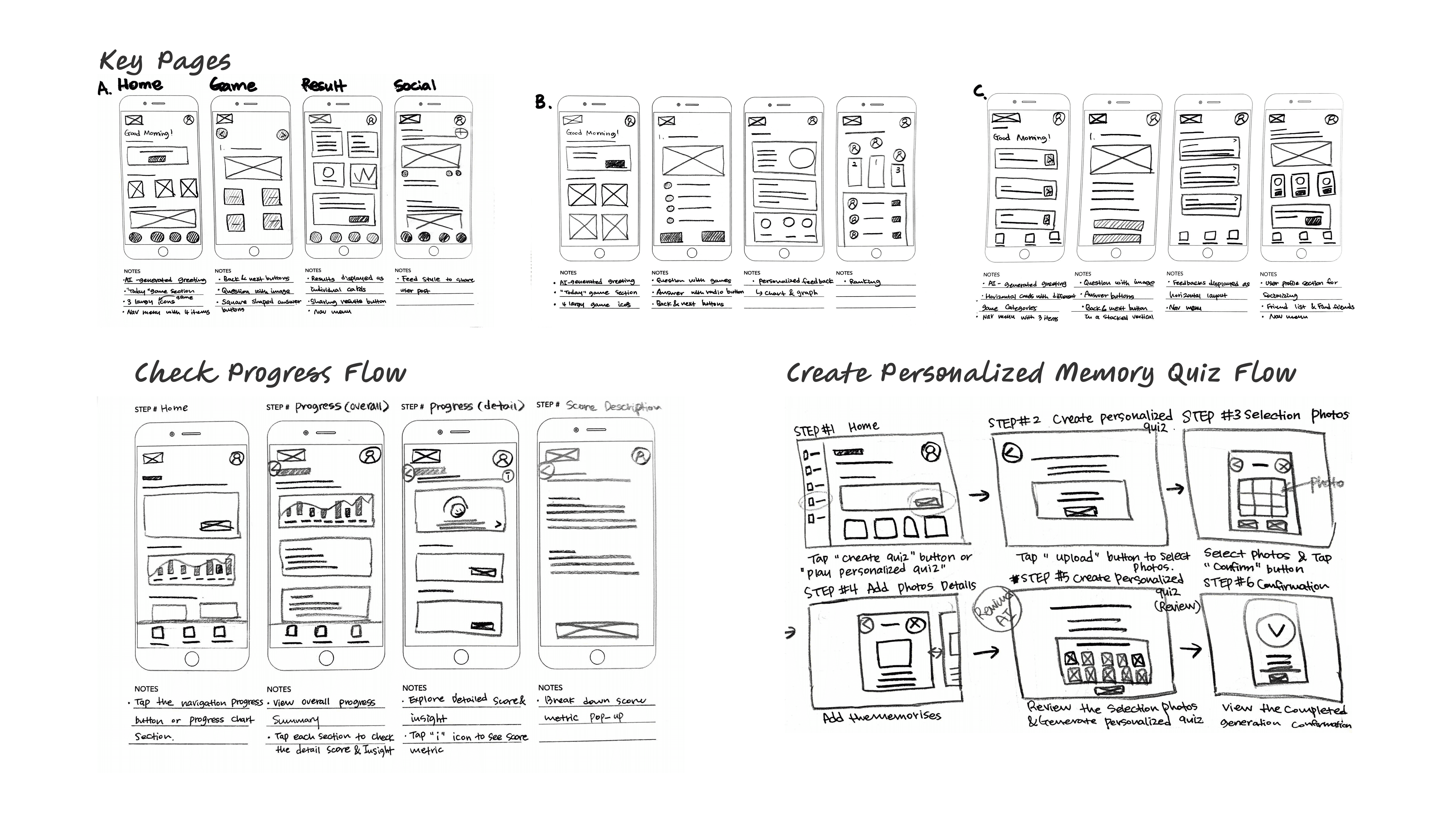
I developed rapid sketches for three core user flows across mobile, tablet, and web, ensuring a consistent and responsive interface structure from the ideation stage.
Design System
Systemic Consistency
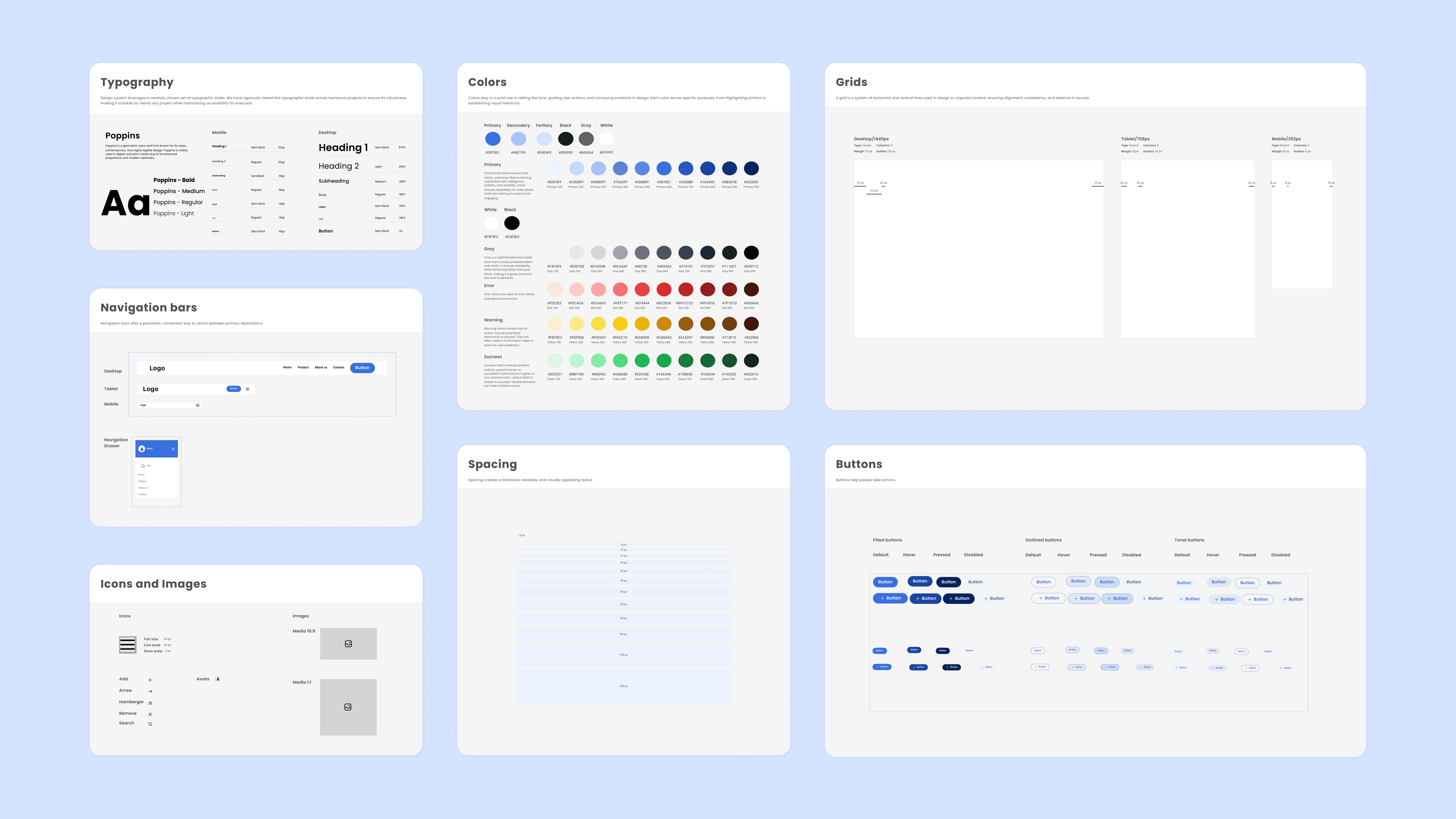
I created a flexible design system to keep patterns, spacing, and interactions consistent across the experience while making future updates easier to manage.
Accessibility Standard
The visual system uses clear typography, strong contrast, and simplified hierarchy to improve readability for older adults. Poppins was selected for its open letterforms, and the color system was designed to meet WCAG 2.1 contrast requirements.
Component Design
Components are designed with clear states, familiar patterns, and easy to tap controls to support more confident navigation for older adults.
Systemic Consistency
I created a flexible design system to keep patterns, spacing, and interactions consistent across the experience while making future updates easier to manage.
Accessibility Standard
The visual system uses clear typography, strong contrast, and simplified hierarchy to improve readability for older adults. Poppins was selected for its open letterforms, and the color system was designed to meet WCAG 2.1 contrast requirements.
Component Design
Components are designed with clear states, familiar patterns, and easy to tap controls to support more confident navigation for older adults.


Test
Usability Test
Usability testing revealed areas of confusion on the home page, leading me to clarify navigation, add supportive labels, and strengthen the visual hierarchy.


Usability testing revealed areas of confusion on the home page, leading me to clarify navigation, add supportive labels, and strengthen the visual hierarchy.
Reflection
Key Takeaway
01
Simplicity builds Trust for non-tech-savvy users.
Minimalist interactions significantly increased user confidence and engagement during testing.
02
Aligning User Value with Business & Tech Feasibility.
Collaborating with a business major and a professional engineer ensured our design decisions were grounded in both market strategy and technical feasibility.
03
AI as a tool for Empathy, not just efficiency.
Leveraging AI enabled hyper-personalized feedback that adapted to the user's emotional journey.
01
Simplicity builds Trust for non-tech-savvy users.
Minimalist interactions significantly increased user confidence and engagement during testing.
02
Aligning User Value with Business & Tech Feasibility.
Collaborating with a business major and a professional engineer ensured our design decisions were grounded in both market strategy and technical feasibility.
03
AI as a tool for Empathy, not just efficiency.
Leveraging AI enabled hyper-personalized feedback that adapted to the user's emotional journey.